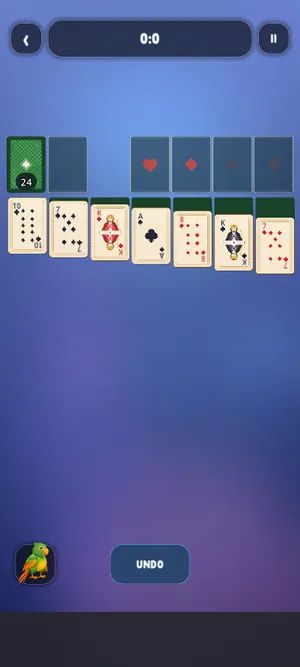
Solitaire – play online for free
Solitaire includes Klondike plus one-, two- and four-suit Spider. Both families reward moves that reveal information and create flexible empty spaces.
A legal move is not automatically useful; prefer moves that uncover cards or unlock a column.
▶ Play for free nowHow to play
Sort to the aces
- Drag cards — stack them down by alternating colors.
- Build the four foundations from ace to king.
- Tap the deck to draw new cards.
- Every deal is solvable — take your time.
Practical strategy tips
- Reveal face-down tableau cards before making cosmetic moves.
- Reserve empty columns for kings or useful sequences.
- Ask what information each move creates.
- Learn Spider with one suit before adding more suits.
Strategy
Klondike rewards a fixed working order: before you tap the deck, run through every possible tableau move, because each shift changes what the next card is worth. While you cycle, memorise the cards you will soon need; on the next pass you will know exactly which card comes next and where it belongs. Treat the tableau as your workshop and the draw pile as a mere reserve, a list to be consulted rather than a slot machine.
In Spider, build descending runs within one suit whenever possible. Only clean same-suit runs move as a unit, and a complete king-to-ace sequence leaves the tableau automatically. Empty columns are valuable temporary storage, so do not occupy one with a short mixed stack when it could help assemble a long clean run. Before dealing from the stock, fill every empty column and anticipate that one new card will land on each of the ten columns.
Common mistakes
- Recycling the deck while useful tableau or foundation moves remain. Each restart carries a score penalty, so begin a new pass with a concrete target.
- Building mixed-suit stacks in Spider on spec. Every mixed run must be laboriously unpicked later; plan suits from the start.
- Manoeuvring kings onto free spots at any cost, even when no buried gain waits behind them. A king that unlocks nothing just blocks the column.
Game modes
Classic
Draw 1 card - easier, relaxing
Spider Easy
Spider Solitaire - 1 suit
Spider Medium
Spider Solitaire - 2 suits
Spider Hard
Spider Solitaire - 4 suits
Where the game comes from
Patience games appeared in northern Europe in the late 18th century and were originally laid out for fortune telling rather than amusement. Collections with hundreds of single-player layouts followed in the 19th century.
The version played here is named after the Klondike gold rush of 1896. Not every deal can be won — which is why the deals here are checked in advance: only those with a proven solution are dealt.
Frequently asked questions
What does the draw-one mode mean?
You turn over one card at a time from the deck, which keeps the round calm and plannable. Each card appears on its own, so you can line up your moves around it before the next one shows.
How do the Spider levels differ?
By the number of suits in play: the easy level uses one suit, the medium two, the hard all four. More suits mean more matching work while sorting, though the underlying rules stay the same.
Can I undo moves?
Yes, through the undo function. Use it as an exploration tool: try a line, look one step ahead, and take it back when the move opens less than you hoped.
Why play Solitaire on FunPort?
- Every deal is a small planning project of its own.
- Patience pays: the right move usually shows up later.
- Klondike and Spider train sorting logic in different ways.