Block Fit – play online for free
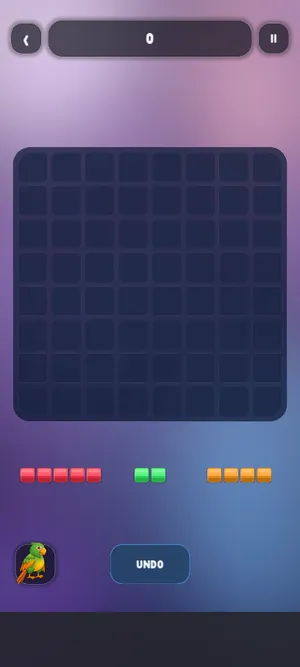
Block Fit is a calm spatial puzzle on an 8×8 board. Pieces wait in the tray until you place them, so planning room for all three shapes matters more than reaction speed.
Short sessions begin gently but grow into a demanding exercise in space management.
▶ Play for free nowHow to play
Fit the blocks
- Drag blocks from the tray onto the 8×8 grid.
- Full rows and columns clear away.
- Stuck? Undo takes back your last moves.
- No room left for any block — game over.
Practical strategy tips
- Inspect all three tray pieces before placing the first one.
- Keep the centre flexible and reserve small pieces for awkward gaps.
- Prefer moves that clear a row and a column together.
- Use undo to learn which placement created a dead end.
Strategy
Treat the opening tray as one combined packing problem. Place awkward corners and long bars before easy compact pieces, but only where they leave clean rectangular space. A nearly complete line need not be cleared immediately: keeping one deliberate gap can let a later shape finish both a row and a column. That double clear reconnects useful areas instead of merely increasing the count of empty cells.
As the board fills, measure the largest usable region rather than total vacancies. Protect a broad rectangle for pieces that cannot fit into narrow channels, and use small shapes to repair edges. Before committing, test all three tray pieces mentally in more than one order. Undo is most useful for comparing those sequences and identifying which innocent-looking placement divided the board into unusable pockets.
Common mistakes
- Filling the centre with convenient small pieces fragments flexible space; anchor well-fitting shapes along the outer edges first.
- Planning only the current piece creates avoidable dead ends; reserve plausible positions for every shape in the tray.
- Enclosing a single empty cell usually makes it useless; avoid sealed holes unless a matching one-cell piece is available.
Game modes
Endless Mode
Play forever with increasing speed
Where the game comes from
Filling a shape completely with given pieces is one of the oldest puzzle families there is. A seven-piece dissection puzzle spread through China in the early 19th century and reached Europe soon after, where Victorian publishers printed thousands of silhouettes to be reproduced.
The mathematics arrived in 1953, when Solomon Golomb described shapes made of joined squares and named them polyominoes. His question was whether a given set tiles a rectangle without gaps. That is the question this board asks again on every turn.
Frequently asked questions
Must the three tray pieces be placed in order?
No. You may choose any order, and that freedom is a major part of the puzzle. A small piece can complete a line first, opening enough room for a wide bar or corner that previously did not fit.
What causes a Block Fit run to end?
The run ends when none of the currently offered shapes can fit entirely on the remaining empty cells. A crowded board can therefore continue as long as at least one whole piece still has a legal placement.
Why are simultaneous row and column clears valuable?
One placement can finish a horizontal and vertical line at once. Both disappear, often joining separate empty regions into a larger usable area. That improved geometry matters more than simply counting how many cells were removed.
Why play Block Fit on FunPort?
- Three visible shapes turn every move into a compact planning exercise.
- Spatial judgment matters without demanding fast reactions or memorised openings.
- A single clear can reshape several future placement routes at once.