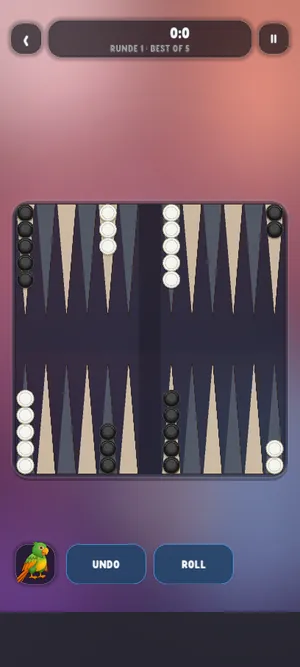
Backgammon – play online for free
Backgammon is a race for fifteen checkers. Dice set the move distances, exposed opposing checkers can be hit, and every checker must reach home before bearing off begins.
Strong play balances racing speed, made points and the risk of leaving single blots.
▶ Play for free nowHow to play
Race your checkers home
- Roll the dice — each die is one move.
- Tap a checker, then tap a highlighted point.
- Lone enemy checkers can be hit and sent back.
- Bring all 15 home first, then bear them off to win.
Practical strategy tips
- Secure important points with at least two checkers.
- Use all four moves of a double carefully.
- A checker on the bar is most valuable when your home board is closed.
- Bear off only after all fifteen checkers are home.
Strategy
Use the opening to establish valuable points with pairs while keeping the rear checkers mobile. Judge the two dice by positional effect rather than distance alone. An exposed advance may prepare an anchor or new point, but it can also be hit. After each partial move, count which opposing rolls could reach every blot before deciding how to spend the remaining die.
During the middle game, decide whether the position calls for racing, blocking or contact. When ahead in the race, reduce needless exposure and guide checkers home efficiently. When behind, anchors and closed points can preserve hitting chances. During bearing off, spread checkers so many future rolls remain useful; remember that doubles provide four separate moves and can change the distribution dramatically.
Common mistakes
- Using every die for maximum distance leaves avoidable blots; build secure points and connected checkers before racing blindly.
- Forgetting a checker on the bar makes other plans illegal; re-enter it before attempting any move elsewhere.
- Committing to a pure race too soon gives up contact chances; compare both full positions before disengaging.
Game modes
VS Computer
Play against the computer
Local 2P
Play with a friend
Online PvP · Online
Play against a real opponent online
Where the game comes from
Nothing on this site is older. A board found in the royal tombs of Ur dates to around 2600 BCE and was played with dice and pieces along a track. The Romans played a strikingly similar version across twelve points.
The modern shape, with its doubling cube, only appeared in New York clubs during the 1920s. It turned a dice game into an exercise in probability: the roll matters less than knowing when to raise the stakes and when to walk away.
Frequently asked questions
Must both dice be played on a turn?
When legal moves exist for both values, both must be used. They may move separate checkers or the same checker in sequence. A double supplies four individual moves of the rolled value.
What happens when an exposed checker is hit?
A lone opposing checker can be sent to the bar. Its owner must re-enter it through the opponent's home board before moving any other checker, which can be difficult when several entry points are closed.
When can bearing off begin?
All fifteen of your checkers must first stand inside your home board. Suitable dice then remove them from play. The winner is the first player to bear off the final remaining checker.
Why play Backgammon on FunPort?
- Each dice roll supports several strategically distinct move orders.
- Racing and blocking can exchange importance within one position.
- Exposed checkers make calculated risk immediately visible on the board.