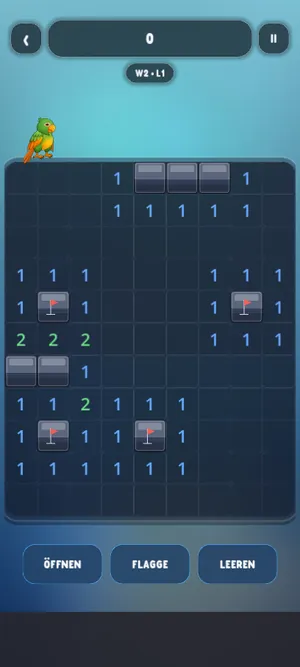
Minefield – play online for free
Minefield reveals numbers that count adjacent mines; a long press places a flag. Campaign boards are designed to be solvable by logic rather than guessing.
Progress comes from combining overlapping number constraints safely.
▶ Play for free nowHow to play
Clear the minefield
- Tap to reveal a cell — long-press to flag a mine.
- Numbers show how many mines touch that cell.
- Use logic — every board is solvable without guessing.
- Reveal every safe cell to win.
Practical strategy tips
- When a clue already has enough flags, its other neighbours are safe.
- When a clue equals its unknown neighbours, all of them are mines.
- Open large safe areas before analysing hard edges.
- Recheck flags whenever a contradiction appears.
Strategy
Work outward from settled clues. If a number already touches the same number of flags, every other covered neighbour is safe. If the clue instead equals its flags plus all remaining unknown neighbours, those unknown cells are mines. Apply both tests again after every reveal. Corners and borders involve fewer neighbours than central cells, so they often provide the cleanest place to begin a chain of deductions.
When no single clue decides a move, compare two neighbouring clues. Separate their covered neighbours into shared and exclusive groups; the difference between the clue counts can reveal a forced mine or safe cell. Place flags only when certain, because an incorrect flag corrupts later deductions. Campaign boards are designed to be solved without guessing, and hints can assist at dead ends. Revealing an actual mine ends the attempt immediately.
Common mistakes
- Confusing a tap with a long press. A tap reveals the cell, while a long press flags it; verify the gesture before risky cells.
- Writing edge regions off as unsolvable and revealing at random. Corners and borders enclose fewer neighbours, so their numbers often read clearly.
- Opening more cells at random once numbers contradict each other. Resolve the contradiction first: one of the marks involved is wrong.
Game modes
Standard Campaign
Standard campaign progression
Where the game comes from
The roots lie in logic games of the 1960s and 70s in which a hidden pattern had to be deduced from clues. The genre reached everyone from 1990, when it came bundled with a widely used operating system — reportedly to teach people how to use a mouse.
After the first click it is pure deduction, with one exception: some positions cannot be resolved and demand a choice. Strong players recognise those and guess where being wrong costs the least.
Frequently asked questions
How do I mark a mine?
A long press on the suspicious cell places a flag. It helps you sort dangerous cells in your head, while the revealed numbers next to it tell you how many mines actually touch.
Will I ever have to guess?
No, the campaign boards are built so that logic alone clears them completely. When you get stuck, an overlooked number relation is usually at fault; a fresh look at the neighbourhood beats an attempt.
What happens if I hit a mine?
In the campaign that one mine ends the level attempt, and you can restart from there. Failed attempts still teach: the hit shows which number relation you skipped.
Why play Minefield on FunPort?
- Learning to read number patterns transfers to many other puzzles.
- Every revealed cell hands you fresh, usable information at once.
- Skipping the guesswork rewards clean thinking with visible progress.